Saturday, November 1, 2014

Erik Hove Chamber Ensemble - Saturated Colour

Erik Hove Chamber Ensemble
Saturated Colour 

Erik Hove - Saxophone, flute, clarinet
Anna Webber - Flute
Krisjana Thorsteinson - Oboe
Bradley Powell - Clarinet
Andy King - Trumpet
Josh Zubot - Violin
Thomas Quail - Viola
Jane Chan - Cello
Remi-Jean Leblanc - Bass
Evan Tighe - Drums 

Erik Hove is a Canadian musician that came to my attention via Anna Webber, who plays flute in his Ensemble, and who recently released an excellent disc of her own, SIMPLE. His ten-piece group features a jazz rhythm section married to a small contemporary chamber ensemble, and as he states, “explore(s) a synthesis of contemporary compositional concepts with current ideas from jazz and improvised music…” 

Hove composed all the selections and plays woodwinds on Saturated Colour. It took me a minute to get used to the unusual harmonies he uses, but once I acclimated I was all in. It reminds me a little of Steve Lehman’s Octet, and no wonder, as both Lehman and Hove have been influenced by the spectral techniques of composers such as Murail. Both Hove and Lehman play alto, and both have a tart, angular style. But Hove definitely has his own take on the spectral school, with more pastel shading to his music and a more impressionistic approach vs. Lehman. 

The spectral influence does result in that unique shimmering sound that I noted in my review of Lehman’s Mise en Abîme, and as I listened to Saturated Colour I had the feeling of being held in suspended animation. Hove makes beautiful use of the combination of woodwinds and strings in the arrangements, such as on the track Ascending. There’s a slight third-steam influence here as well, which I really dig, but without the stiffness or stuffiness that is sometimes ascribed to that movement.

This is an intriguing CD whose subtle charms reveal themselves through repeated listens. At times it sounds as if it might veer off into Gil Evans-influenced big band territory, but then Hove will throw in a curve ball to prevent things from getting too comfortable. 

Enigmatic, in a good way.

Wednesday, October 22, 2014

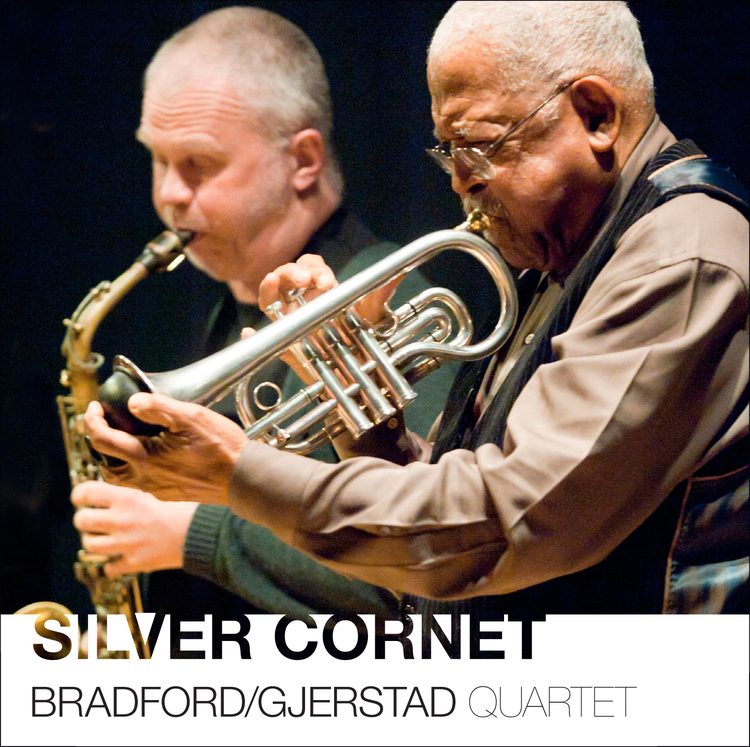
Bradford/Gjerstad Quartet - Silver Cornet

Silver Cornet
Bradford/Gjerstad Quartet
Nessa Records

Bobby Bradford – Cornet
Frode Gjerstad – Alto sax, clarinet
Ingebrigt Haker Flaten – Double bass
Frank Rosaly - Drums

Silver Cornet was recorded in March of this year at the Windup Space in Baltimore, the last stop on the Quartet’s North American tour. I had the pleasure of attending their Dallas performance a few night’s earlier; Yells At Eels' Dennis Gonzalez had coaxed them up between their Austin and Houston dates.

When I walked in to the concert venue, I saw a man with a cornet in his lap, sitting alone in a corner. Thus, I was able to actually meet Mr. Bradford and soak in his tales of growing up in Fort Worth and the legends he had played with. Later on I was able to meet the other members of the group; definitely a wonderful experience that I documented on this blog.

The instrumental line-up and Bradford’s history would suggest that their music would be heavily influenced by Ornette, but at least as a listener that’s not really the case. In fact, the Quartet really reminds me of Other Dimensions In Music in the way the music rises and falls in a very natural way.

Bradford has what I call an “organic” approach to improvising; everything flows, nothing seems forced, and it’s very conversational. You really hear the history of jazz and free music in his playing. 

Listening to Frode is like what I imagine watching Pollock at work was like: At first everything looks random and disconnected, but over the course of time you see an arc, a progression. He infers, rather than states, and he’s a great foil for his front-line partner.

The acoustics of the Dallas show made picking up the bass difficult, so it’s great to hear Ingebrigt’s contributions so much more clearly. He’s all over his instrument, with a lightening-quick approach that reminds me of Barry Guy at times.

And Frank Rosaly? Well, I’ve never seen anyone play like he does. His approach involves rapidly taking various cymbals off their stands, placing them on top of drumheads, and striking or swiping them. It’s mesmerizing live, and what almost got lost was how well he can drive the band when needed.

Once the Dallas performance was finished, I had a vision in my mind that the music hadn’t really stopped, that it was a river that would keep flowing. Silver Cornet is proof of that.

Here's a clip from this Baltimore performance:

Saturday, October 18, 2014

Wadada Leo Smith - The Great Lakes Suites

Wadada Leo Smith
The Great Lakes Suites

Wadada Leo Smith - Trumpet
Henry Threadgill - Alto sax, flute, bass flute
John Lindberg - Double bass
Jack DeJohnette - Drums

Wadada Leo Smith is undergoing a creative renaissance, with involvement in what seems to be an unprecedented amount of projects over the past few years. Ten Freedom Summers, Occupy The World and the collective that just released the album Red Hill are just a few of the projects that he’s spearheaded or been a part of.

Occupy and several other albums from Mr. Smith have been released by Tum Records of Finland, and now that label gives us The Great Lakes Suite, six compositions by Smith spread over two CDs.

I couldn’t wait to get my hands on this when I learned who was on it, an all-star quartet with Henry Threadgill, John Lindberg and Jack DeJohnette. But beyond the players, it’s the strength of the compositions, particularly the three suites that comprise the first CD, that grabs one’s attention. 

The opening Lake Michigan has an unusual and arresting stop-start theme, with a structure that leads to a couple of false endings over its length. Lake Ontario, which follows, makes excellent use of Threadgill’s arid flute. There’s a sense throughout that the musicians are really taking their time to explore each composition, so that the mind doesn’t really record whether the tempos are fast or slow; everything flows in an organic fashion through to the final suite, the music shuffling off like a freighter moving out to the horizon.

Mr. Smith’s trumpet has always had a majestic quality, with a little hint of Miles, and that is still the case here, but now there’s an additional richness, an emotional resonance, that I don’t remember hearing from him before. I was looking forward to hearing Threadgill in a context other than his own groups, and he doesn’t disappoint. His solos seem to be more about juxtaposing interesting textures and building blocks of sound in interaction with the other players, rather than providing strict linear narratives.

It’s a treat to hear Lindberg and DeJohnette, both of whom just kill throughout Suites. I don’t know why we don’t see more of Lindberg, but I’m glad Smith uses him regularly, and DeJohnette is all over his kit, bringing to mind his hyperactive work with Miles during the Fillmore days. 

Overall, the first CD is the slightly stronger of the two, mainly due to the aforementioned first two compositions, but that’s a minor quibble. There’s a lot that will keep you coming back to The Great Lakes Suite.

Sunday, October 5, 2014

RED Trio & Mattias Ståhl - North And The Red Stream

RED Trio & Mattias Ståhl
North And The Red Stream

Rodrigo Pinheiro - Piano
Hernani Faustino - Double bass
Gabriel Ferrandini - Drums
Mattias Ståhl - Vibraphone

I have to admit its taken me a while to fully warm up to the RED Trio. What I had heard of their previous releases, particularly those with guest artists John Butcher and Nate Wooley, had seemed a little too “pointillist” for my tastes. But I liked what I heard from individual members’ contributions to records such as Clocks & Clouds with Luis Vicente, and now the Trio has released a fabulous recording of a 2013 live concert with vibist Mattias Stahl.

What I’ve come to appreciate about the RED Trio is this great sense of architecture they bring to what they create in the moment. The performance as released consists of three pieces ranging from 16 to 20 minutes each, and it’s fascinating to hear how each develops. One moment the group will be engaged in intense interplay, then turn on a dime to sparse sections with what sounds like prepared piano and percussive interjections from Ferrandini. For a small group, they create an impressive set of textures. 

The more intense sections of this performance remind me of The Feel Trio. Pinheiro’s playing has some of Cecil Taylor’s markers, but he’s developed his own vocabulary that contains more use of space and silence than any of Taylor’s work, along with the way he dampens his strings to generate percussive effects. Guest Stahl fits right in with a metallic flavor to his vibes, and sounds like a permanent member of the group.

The RED Trio is known for their democratic interaction, and they don’t disappoint here. As I write this, I realize it’s somewhat useless to single out any one member’s contributions, as one might when listening to a traditional piano trio. Every time I listen to North, and no matter how hard I try to focus on one member at a time, I end up perceiving the totality of the performance. There are a lot of trios that emphasize “leaderless” group interaction, but the RED Trio takes this to another, unique level.

You can now officially count me as a fan. Now to catch up with all their previous output…(sigh)

Saturday, September 27, 2014

Patrizia Oliva/Gustavo Costa - FROGS

Patrizia Oliva/Gustavo Costa
FROGS

Patrizia Oliva – Voice, stir xylophone, bamboo flute, water, leaves
Gustavo Costa – Drums, cymbals, bells

Here’s one that’s a little outside of my usual listening habits. Oliva and Costa have recorded a continuous 26+ minute track “next to a small lake in Luminasio (Marzabotto, Bologna, Italy).” There are definite elements of a field recording present in the soothing sounds captured in nature, and the two musicians have added vocals and percussion in real time without overdubs. As suggested by the locale, FROGS proceeds in a generally placid, meditative nature until Ms. Oliva adds intensity with her wordless vocal effects.

Friday, September 26, 2014

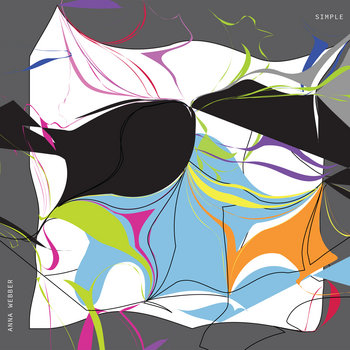
Anna Webber - SIMPLE

Anna Webber
SIMPLE
Skirl Records

Anna Webber - Tenor saxophone, flute, alto flute
Matt Mitchell - Piano, prepared piano
John Hollenbeck - Drums, percussion

SIMPLE is at once an apt and a misleading title for this CD. Saxophonist/flautist Webber, a new name to me, has attracted a couple of A-listers in Mitchell and Hollenbeck for her project, and upon listening it’s easy to see why they wanted to be on board – there’s a lot to sink your teeth into.

Ms. Webber uses only the three instruments to fulfill her compositional vision over the seven tracks of the album. However, she deploys an impressive variety of approaches to the material, from quieter minimalist passages to themes stated in unison to knotty full-bore free improv.

Using only woodwinds, piano and drums creates a lot of open space in the music, and Webber plays in and around the compositions, suggesting they could unspool infinitely. Her tone on tenor is malleable, bending and stretching notes in a way that calls to mind the spirit, if not the exact style, of a young David Murray.

Shifting effortlessly and seamlessly from composed to improvised sections, intricate is the word that best sums up her approach, and if that seems to be contrary to the title of the album, somehow it all fits. She makes the complex simple, which as we all know is harder than making the simple complex.

As soon as SIMPLE had finished, I started over and immediately listened to it again. Now that’s the sign of a good record!