Showing posts with label Pi Recordings. Show all posts

Saturday, August 12, 2017

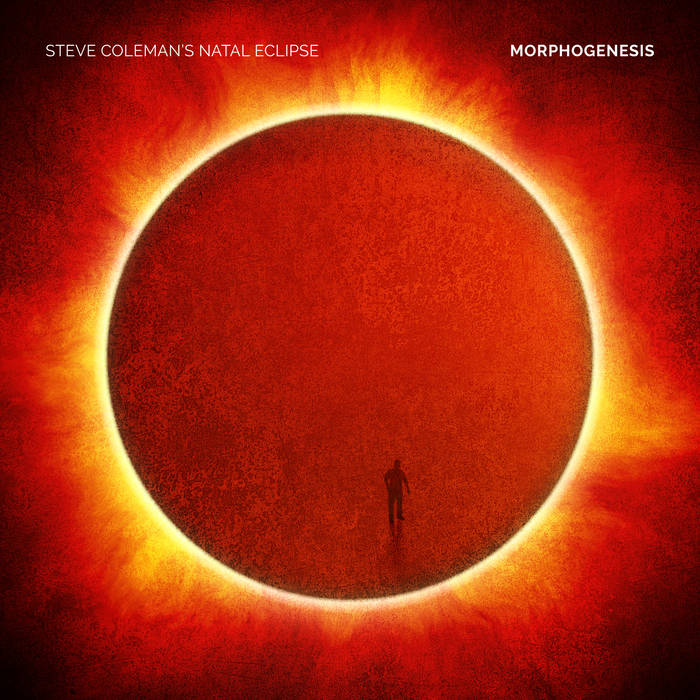
Steve Coleman’s Natal Eclipse - Morphogenesis

Morphogenesis
Steve Coleman’s Natal Eclipse

Steve Coleman - alto saxophone
Jonathan Finlayson - trumpet
Maria Grand - tenor saxophone
Rane Moore - clarinet 
Kristin Lee - violin 
Jen Shyu - vocals 
Matt Mitchell - piano 
Greg Chudzik - bass 
Neeraj Mehta - percussion

Steve Coleman has been undergoing an artistic renaissance since joining Pi Recordings in 2010. His M-Base theories have been hugely influential in contemporary jazz over many years, with followers such as Jonathan Finlayson taking his concepts and providing their own interpretations. I've had reservations about the M-Base style, chiefly that the fixed rhythms on releases such as 1995's Def Trance Beat (Modalities of Rhythm) have tended to anchor in place soloists, including Mr. Coleman, and prevented them from taking full flight.

Coleman has expanded his palette over the course of four Pi releases, and the result has been the best recordings of his career. Morphogenesis continues that streak with what is essentially an ambitious multi-part suite spanning 60-plus minutes. What's impressive is the clarity of the vision and how well the sections hang together to create the whole.

Coleman creates interest by constantly shifting the focus to different instruments in a seamless fashion distinct from the traditional jazz solo. Rhythms are more supple and varied than in his earlier works. The cyclical effect of the compositions' structures bears a faint resemblance to Anthony Braxton's Ghost Trance music, although Coleman is his own person as a composer and player.

There were a couple of sections that I felt overstayed their welcome, but overall Morphogenesis is another impressive milestone in Steve Coleman's career.

Thursday, March 30, 2017

Miles Okazaki - Trickster

Miles Okazaki - Trickster

Miles Okazaki - guitar
Craig Taborn - piano
Anthony Tidd - bass
Sean Rickman - drums

Trickster is an apt name, as what at first seems like a quiet, unassuming recording turns into an unexpected delight with further investigation. Okazaki has accomplished a difficult feat: Making a record that is both adventurous and accessible. 

Okazaki and his group take Steve Coleman’s M-Base concepts and apply their own interpretation, one which encompasses complex rhythms married to compositions with attractive melodies, even hints of the blues and boogie-woogie.

Okazaki has a quiet style that fits the music perfectly, and Craig Taborn does his usual fantastic job of fitting into a group concept and bringing his point of view. Tidd and Rickman are less well known to me, but provide sure-handed support in support of the mood of each piece.

Miles Okazaki has taken a huge leap forward in his evolution as an artist with Trickster.

Saturday, October 1, 2016

Tyshawn Sorey - The Inner Spectrum of Variables

Tyshawn Sorey
The Inner Spectrum of Variables
Pi Recordings

Tyshawn Sorey - composer, conductor, drum set
Christopher Tordini - contrabass
Cory Smythe - piano
Chern Hwei Fung - violin
Kyle Armbrust - viola
Rubin Kodheli - cello

I realize that I’m late to the game on this one, even though I’ve been listening to it ever since it came out earlier this year. I’ve hesitated to review it, because I feel ill-equipped to comment on a work that is so informed by the classical music tradition. 

However, on its own merits The Inner Spectrum of Variables is an ambitious work that deftly combines strings, piano and percussion to make an assured, mature statement as a composition. Given that Sorey is one of the best jazz drummers working today, you might expect Variables to be heavy on percussion, but in actuality the accents are subtle. Cory Smyth is wonderful, as he was on Sorey’s trio album from 2014, Alloy.

Sunday, March 20, 2016

My favorite things, pt. 2: Pi Recordings

Some labels put out a plethora of releases each year, and of course we should all be grateful that they do. Others, like Pi, issue a handful of what feel like carefully curated albums that cause you to really focus your attention. The most recent, save one, is drummer Dan Weiss’ Sixteen: Drummer’s Suite, which pays indirect tribute to famous drummers who have influenced him in one way or another. I say indirect because the suite doesn’t mimic any past styles but makes a very comprehensive statement of its own. 

I wasn’t a fan of Weiss’ previous Pi release, Fourteen, because it felt like a pastiche, with styles grafted onto each other. He’s taken a major step forward with Sixteen, displaying complete mastery in combining acoustic instruments, electronics, voice and percussion. Some themes remind me of the open, endless blue sky style of John Hollenbeck’s Large Ensemble, but Weiss is his own man, and he has birthed a masterwork. 

The most recent Pi Recordings release ,which I haven’t yet heard, is Henry Threadgill’s Old Locks and Irregular Verbs.

Saturday, November 7, 2015

Matt Mitchell - Vista Accumulation

Matt Mitchell
Vista Accumulation

Chris Speed - Tenor Saxophone, Clarinet
Matt Mitchell - Piano
Chris Tordini - Bass
Dan Weiss - Drums

I like albums that take you somewhere, a journey, maybe to somewhere inside of yourself, or perhaps bringing back flashes of memories. This is what happens when I listen to Vista Accumulation, pianist Matt Mitchell’s new 2 CD set on Pi.

I was skeptical when I first heard about this project, primarily because two CD’s worth of material is ambitious for an artist I perceived as relatively new on the scene. However, Mitchell is 40 and has been featured on Tim Berne’s three ECM albums as well as with Dave Douglas’ quintet. I was also curious, because Mitchell fits in with so many diverse situations I wasn’t sure what I’d hear.

Vista Accumulation manages to sustain a mood and thematic unity over the course of 95 minutes, without exhausting the underlying ideas. His approach is an intriguing mix of impressionism and modern classical, and frankly there’s nothing overtly “jazzy” in his approach to his eight compositions. Lines unfold in an unhurried way, and the mostly medium tempos give the group time to explore the material, with Chris Speed’s clarinet a highlight. Chris Tordini and Dan Weiss create subtle, shifting patterns underneath, ripples spreading across the music.

Perhaps it’s fitting that I’m absorbing Vista as the seasons change from summer to fall. I can see the flashes of dark gold and amber, mixed in with dark greens and browns. It’s a story that is yet to fully unfold, and I’m ready for the next chapter.

Bonus: For an unintentionally amusing review of Vista Accumulation, go here.

Sunday, September 21, 2014

Hafez Modirzadeh - In Convergence Liberation

Hafez Modirzadeh
In Convergence Liberation

Hafez Modirzadeh - Saxophones, flute, clarinet, percussion
ETHEL - Cornelius Dufollo: violin; Ralph Farris: viola; Dorothy Lawson: cello; Mary Roswell: violin
Mili Bermejo - Vocals
Amir ElSaffar - Trumpet. vocals, sanfur
Amir Abbas Etemadzadeh – Tonbak, daf, dohol, bells
Faraz Minooei - Sanfur

Sometimes it takes a set of circumstances to make an album click. Driving home from work in the early evening after an exhausting week, I put on In Convergence Liberation and let it take me where it wanted to go.

Something about the solemn melody of the opening track, La Angustia de Los Amantes (“Lover’s Agony”) and Mili Bermejo’s soulful rendition in Spanish of a 13th century Persian poem made a connection with me, speaking some truths about life’s struggles, breaking through barriers of culture and language. It transported me out of that specific time and place, and gave me a perspective beyond my immediate concerns. I suppose that’s one of the main reasons we listen to music.

With In Convergence Liberation, Hafez Modirzadeh has accomplished an extremely skillful blending of jazz, avant-garde classical, and Persian as well as Iberian music. The record proved somewhat difficult to wrap my head around, and write about, because with its diversity of approaches and instrumentation, along with its length over 18 tracks, Liberation at first sounds like two or even three different albums.

It was when I began focusing on the strings that I realized that they serve as the unifying thread throughout the record. Far from a “reeds with stings” date, the writing for the ETHEL string quartet is complex and deftly woven into each piece. In fact, the 4-part Suite Compost solely featuring the quartet is one of the highlights of the entire album.

In addition to the strings, Modirzadeh blends his reeds, the trumpet of Amir ElSaffar, Ms. Bermejo’s voice, and traditional Persian instruments such as the tonbak (goblet drum) and daf (frame drum) into a unified whole. Certain tracks, such as the aforementioned La Angustia bring more of the Persian musical influence, and others, such as Number That Moves featuring Modirzadeh’s plaintive alto, will remind one of Ornette Coleman.

Even with all I’ve described, I’ve barely scratched the surface of Hafez Modirzadeh’s musical world, which also includes gamelan music, motifs from Beethoven and string quartet music from Mozart to Bartok. Through all these connections, Modirzaheh makes connections with life, with the beauty in art and with the human experience that connects us all.

Here's a performance of Number That Moves, excerpted from a July, 2011 performance in San Francisco with ETHEL and Amir Abbas Etemadzadeh:

Thursday, July 17, 2014

Steve Lehman Octet - Mise en Abîme

Steve Lehman Octet
Mise en Abîme 

Steve Lehman - Alto Saxophone and Live Electronics
Jonathan Finlayson - Trumpet
Mark Shim - Tenor Saxophone
Tim Albright - Trombone
Chris Dingman - Vibraphone
Jose Davila - Tuba
Drew Gress - Bass 
Tyshawn Sorey - Drums

Mise en Abîme
 returns the same personnel as Lehman’s breakout 2009 album Travail, Transformation and Flow. Since then, he’s partnered with Rudresh Mahanthappa for Dual Identity and released an under-appreciated trio album, Dialect Flourescent, on which he radically deconstructed some standards. Mise features a mix of Lehman’s own compositions alongside three Bud Powell tunes and a nod to hip-hop on one track.

The title Mise en Abîme appears to be a play on words combining two concepts, "mise en abyme", a formal technique in which an image contains a smaller copy of itself, appearing to recur infinitely, and “abîme”, the geographical term for a vertical shaft that opens into a network of subterranean passages. The connotation clearly is one of layers spreading in many directions, perhaps a reference to Lehman’s fascination with spectral harmony. 

Spectral harmony organizes overtones of different instruments according to their frequencies as opposed to the intervals of a musical scale. Using this technique, along with harmonic movement to different tonal centers, Lehman constructs a shimmering, vibrating sound that incorporates elements of new music, jazz and electronic music.

The combination of Lehman’s ascetic alto, the intricate yet melodic compositions, and the overtones created, particularly by the vibraphone, creates a signature sound. Vibist Chris Dingman plays a key role, prominent in the mix, his dense ringing overtones a continual presence in both solo and ensemble sections.

There’s always been an element of emotional distance in Lehman’s music, but it serves here to create an air of mystery. The combination of the geometric arrangements and ringing vibes create a feeling of suspended animation. The last track, Parisian Thoroughfare Transcription, features Lehman playing over what sounds like samples of distant voice and piano, and comes across as a throwaway compared to what has come before. But it doesn’t distract from the quality of the seven previous tracks.

The fact that Mise is a consolidation of Travail shouldn’t be considered damning with faint praise. It’s a confirmation of Steve Lehman’s talents as conceptualizer and composer, synthesizing influences such as Jackie McLean, Anthony Braxton, spectral composer Tristan Murail, and M-Base. There’s no other group out there that sounds like this.